JEE Advanced 2026 Paper 1, Chemistry Section 3 Q3: Carboxylic Acid Derivatives
Learn this concept: Carboxylic Acid Derivatives →
The sum of total number of carbonyl groups (>C=O) present in the major products and in the following reactions is _____.
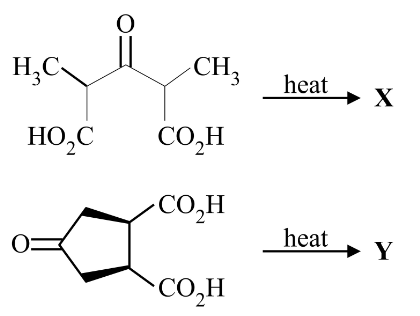
- Reaction (i): heating 2,4-dimethyl-3-oxopentanedioic acid gives
- Reaction (ii): heating cis-4-oxocyclopentane-1,2-dicarboxylic acid gives , with both COH groups on the same face
- Find the total number of C=O groups in and
Steps
Classify the acids in reaction (i)
In reaction (i), each COH carbon is joined to a carbon that carries the central ketone. Both acid groups are therefore β-keto acids.
\ce{HO2C-CH(CH3)-CO-}Decarboxylation gives X
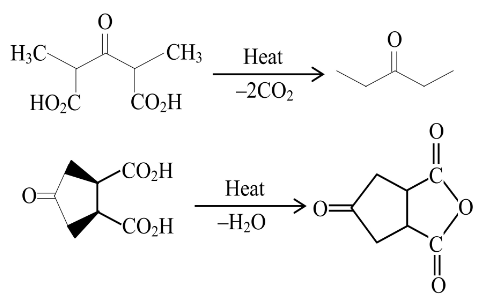
On heating, each loses CO through a cyclic six-membered transition state and gives an enol, which tautomerises. After both groups decarboxylate, the product is = pentan-3-one, which has 1 C=O.
\ce{CH3CH2COCH2CH3}Classify the acids in reaction (ii)
In reaction (ii), the ring ketone sits two carbons away from each ring carbon that carries a COH group. These are γ-keto acids, so they do not decarboxylate easily.
Cis diacid forms an anhydride
The two COH groups are on adjacent ring carbons and on the same face (cis). On heating they lose HO to form a five-membered cyclic anhydride fused to the cyclopentanone ring.
 Key stepThe two cis COH groups can reach each other.
Count C=O groups in Y
keeps the ring ketone (1 C=O) and gains two anhydride C=O groups, giving 3 C=O in total.
\ce{-CO-O-CO-}Add the two counts
The sum of C=O groups in and is:
Concept behind this question
Carboxylic Acid DerivativesNotes, formulas and examples →More previous year questions on Carboxylic Acid Derivatives
Practice more Chemistry Section 3
Concept-wise practice with instant solutions on Fundamenthol.
Start practicing →