JEE Main 2026 Apr 8 Shift 2, Chemistry Q17: Carboxylic Acid Derivatives
JEE Main2026Apr 8, Shift 2Chemistry
Learn this concept: Carboxylic Acid Derivatives →
Q.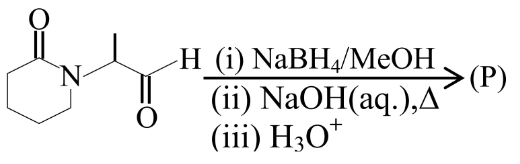
Consider the following reaction.
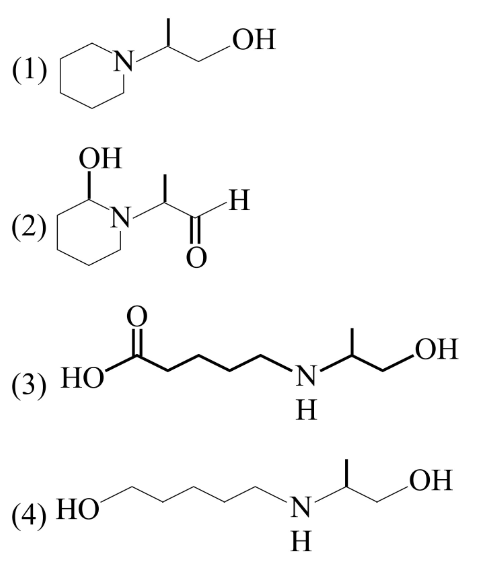
The major product (P) formed is :
- A
1
- B
2
- C
3
- D
4
Solution
Given
- A 2-piperidone (a six-membered lactam) whose ring N carries the side chain
- Reagents: (i) NaBH/MeOH, (ii) NaOH(aq), , (iii) HO
IdeaNaBH reduces aldehydes but not amides. Hot aqueous base then hydrolyses the lactam C(=O)–N bond, which opens the ring.
Steps
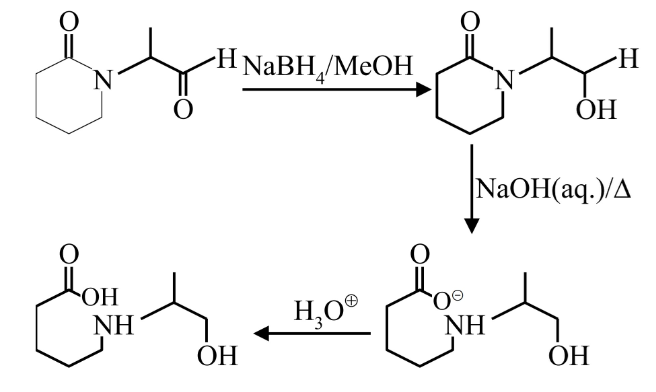
NaBH4 reduces only the aldehyde
The molecule is monocyclic and has two carbonyl groups: the ring amide C=O of the lactam and the side-chain CHO. NaBH reduces only the aldehyde. The lactam is unchanged.
Key stepNaBH does not reduce amides, so the lactam carbon is still a carbonyl when the base hydrolyses the ring.Base opens the lactam ring
NaOH(aq), : hydroxide attacks the lactam carbonyl and the ring C(=O)–N bond breaks. The ring opens to a carboxylate at one end and a secondary amine at the other.
Count the chain carbons
The piperidone ring has one C=O carbon and four CH carbons between it and N. The open chain is therefore C=O followed by , which is a 5-aminopentanoic acid skeleton.
Acid workup gives the acid
HO workup protonates the carboxylate.
AnswerOption C:
TrapA student who believes NaBH reduces the lactam C=O as well as the aldehyde converts the ring amide into a piperidine and picks the amino alcohol of Option A. In fact NaBH leaves amides untouched, so the lactam carbonyl survives and is hydrolysed by hot NaOH.
Concept behind this question
Carboxylic Acid DerivativesNotes, formulas and examples →More previous year questions on Carboxylic Acid Derivatives
Practice more Chemistry
Concept-wise practice with instant solutions on Fundamenthol.
Start practicing →