NEET 2026, Chemistry Q18: Properties and Important Reactions of Aldehydes & Ketones
Learn this concept: Properties and Important Reactions of Aldehydes & Ketones →
Compound P(CHO) gives a red orange precipitate with 2,4-DNP reagent and it does not reduce Tollens’ reagent. On drastic oxidation with chromic acid, P gives an aromatic product Q that produces effervescence on treating with aq. NaHCO. Compound P and Q, respectively, are :
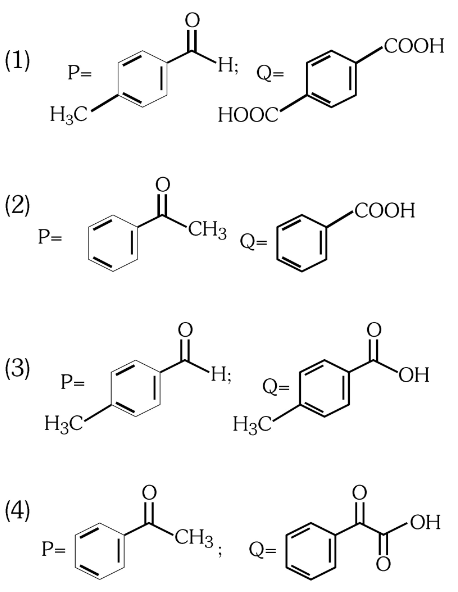
- A
1
- B
2
- C
3
- D
4
- P is
- P gives an orange-red 2,4-DNP derivative
- P does not reduce Tollens' reagent
- Drastic oxidation with chromic acid gives an aromatic acid Q
- Q liberates with
Steps
2,4-DNP test shows carbonyl
A positive 2,4-DNP test means P has a carbonyl group. The two candidate structures, acetophenone and p-tolualdehyde, are both .
Tollens' test rules out an aldehyde
Every aldehyde reduces Tollens' reagent to a silver mirror, an aldehyde on a benzene ring included. P does not, so P is not p-tolualdehyde (Options A and C). P is the ketone acetophenone, .
Drastic oxidation gives benzoic acid
Drastic oxidation breaks the side chain down to a single –COOH on the ring. So Q is benzoic acid. Phenylglyoxylic acid (Option D) keeps the C–C bond, which drastic oxidation does not leave intact.
Key stepDrastic oxidation leaves only a single –COOH on the ring, so the side chain is cut down completely.Effervescence with bicarbonate
Benzoic acid is acidic enough to react with bicarbonate. This is the effervescence.
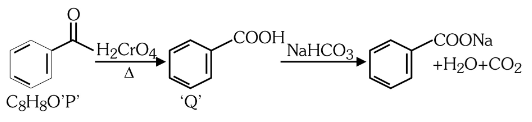
Rule out Option C
Option C fails because drastic chromic acid oxidation would not leave the ring –CH unchanged. It would give terephthalic acid, not p-toluic acid.
Concept behind this question
Properties and Important Reactions of Aldehydes & Ketones Notes, formulas and examples →More previous year questions on Properties and Important Reactions of Aldehydes & Ketones
Practice more Chemistry
Concept-wise practice with instant solutions on Fundamenthol.
Start practicing →