NEET 2025, Chemistry Q31: Introduction to Mechanism of Organic Reaction
Learn this concept: Introduction to Mechanism of Organic Reaction →
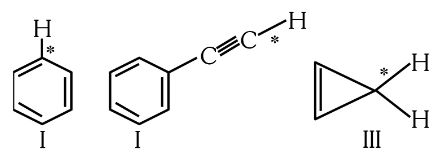
Among the given compounds I-III, the correct order of bond dissociation energy of CH bond marked with is:
- A
II > I > III
- B
I > II > III
- C
III > II > I
- D
II > III > I
- I: aryl CH of iodobenzene
- II: terminal alkyne CH of phenylacetylene
- III: ring CH CH of cyclopropene, next to the C=C
Steps
Alkyne CH in II
In II the starred carbon is sp hybridised (50% s-character). The CH bond is short and strong. The alkynyl radical formed has its odd electron in an sp orbital, out of line with the system, so it gets no resonance help. II has the highest BDE.
Aryl CH in I
In I the starred carbon is sp (33% s-character). The aryl radical keeps its odd electron in an sp orbital in the ring plane, perpendicular to the aromatic cloud, so it is not delocalised. The BDE is high, but below that of II.
Allylic CH in III
In III the starred carbon is the sp CH of cyclopropene (25% s-character). It is allylic to the ring C=C. This bond is the weakest.
Key stepHomolysis gives a cyclopropenyl radical whose odd electron is delocalised over the adjacent C=C by resonance.Combine both effects
Combining s-character and radical stability:
Concept behind this question
Introduction to Mechanism of Organic Reaction Notes, formulas and examples →More previous year questions on Introduction to Mechanism of Organic Reaction
Practice more Chemistry
Concept-wise practice with instant solutions on Fundamenthol.
Start practicing →