NEET 2024, Chemistry Q39: Introduction to Mechanism of Organic Reaction
NEET2024Chemistry
Learn this concept: Introduction to Mechanism of Organic Reaction →
Q.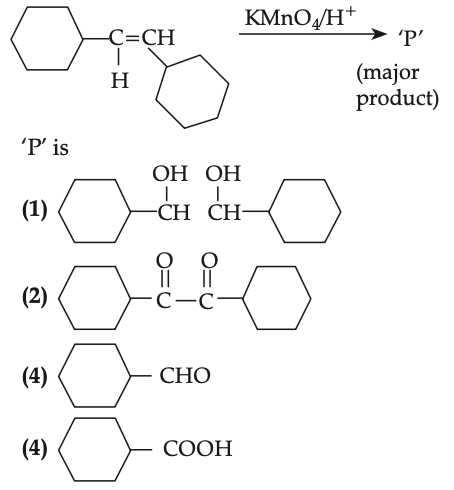
For the given reaction:
- A
1
- B
2
- C
3
- D
4
Solution
Given
- 1,2-dicyclohexylethene,
- Reagent: acidic
IdeaHot acidic permanganate cleaves a C=C bond completely. Each alkene carbon that carries one H ends up as a group.
Steps
Identify the alkene carbons
Both alkene carbons are of the type , where is the cyclohexyl group .
Cleavage gives the aldehyde
first forms the diol, then breaks the C–C bond between the two carbinol carbons. This gives two molecules of cyclohexanecarbaldehyde, .
Aldehyde is oxidised further
It is oxidised further:
Key stepUnder these strongly oxidising acidic conditions the aldehyde does not survive.Overall reaction
Overall: the molecule is symmetric, so cyclohexanecarboxylic acid is the only product.
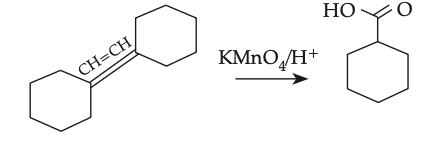
Rule out the other options
The diol in Option A and the aldehyde in Option C are only intermediates. The 1,2-diketone in Option B would need the C–C bond to stay intact, but acidic permanganate breaks it.
AnswerOption D: cyclohexanecarboxylic acid
TrapTreating acidic like ozonolysis with a reductive work-up, students stop at cleavage and pick cyclohexanecarbaldehyde, Option C. Under acidic permanganate the aldehyde does not survive and is oxidised on to the carboxylic acid.
Concept behind this question
Introduction to Mechanism of Organic Reaction Notes, formulas and examples →More previous year questions on Introduction to Mechanism of Organic Reaction
Practice more Chemistry
Concept-wise practice with instant solutions on Fundamenthol.
Start practicing →