JEE Main 2026 Apr 2 Shift 1, Physics Q12: Semiconductors, p-n Junction Diode and Applications
Learn this concept: Semiconductors, p-n Junction Diode and Applications →
For the given circuit (shown in part (A)) the time dependent input voltage and corresponding output are shown in part (B) and part (C), respectively. Identify the components that are used in the circuit between points and .
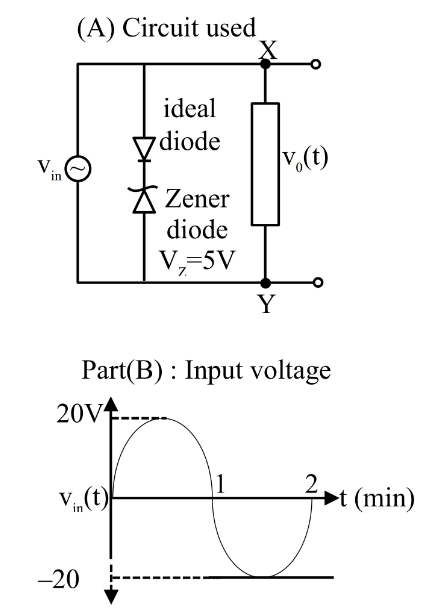
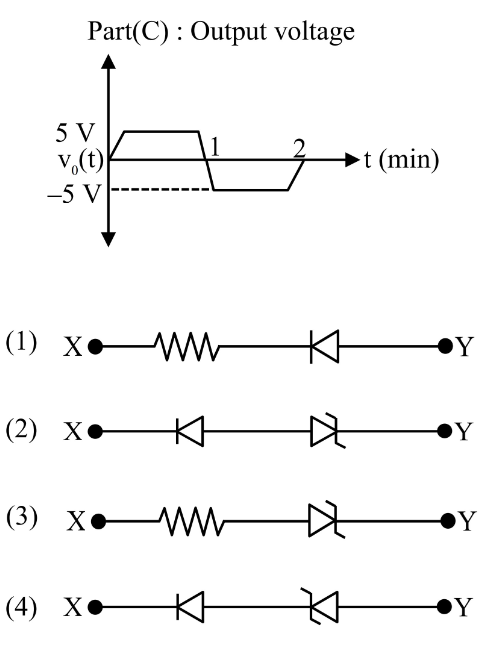
- A
1
- B
2
- C
3
- D
4
- Middle branch: an ideal diode with its anode toward , in series with a Zener ( V) with its cathode toward the diode
- Input is a V sine wave
- Output is clipped flat at V and at V
Steps
Positive half cycle clipping
Positive half cycle ( above ): the ideal diode in the middle branch is forward biased and its Zener is reverse biased. Above V the Zener breaks down, so the output is clipped. For this flat top, the – branch must carry no current.
VNegative half cycle needs X–Y branch
Negative half cycle ( above ): the ideal diode in the middle branch is reverse biased, so that branch is open.
Key stepThe – branch alone must now hold at V, so it needs a reverse-biased Zener and nothing that adds an extra drop.Option B fits both half cycles
Option B: the diode has its cathode toward and the Zener has its cathode toward . When is positive, the diode is reverse biased and the branch is open, as step 1 requires. When is positive, the diode conducts with zero drop and current enters the Zener at its cathode. The Zener breaks down at V, as step 2 requires.
VOption D fails in negative half
Option D: both cathodes face . When is positive, both elements are forward biased, so the output is held near V, not V.
Options A and C fail
Options A and C contain a series resistor. In Option A there is no Zener, so nothing fixes the output at V. In Option C the Zener is forward biased when is positive, which shorts the positive half. In both, the resistor's drop also stops the output from staying flat.
Concept behind this question
Semiconductors, p-n Junction Diode and ApplicationsNotes, formulas and examples →More previous year questions on Semiconductors, p-n Junction Diode and Applications
Practice more Physics
Concept-wise practice with instant solutions on Fundamenthol.
Start practicing →