JEE Main 2025 Jan 22 Shift 2, Chemistry Q13: Resonance & Mesomeric Effect
JEE Main2025Jan 22, Shift 2Chemistry
Learn this concept: Resonance & Mesomeric Effect →
Q.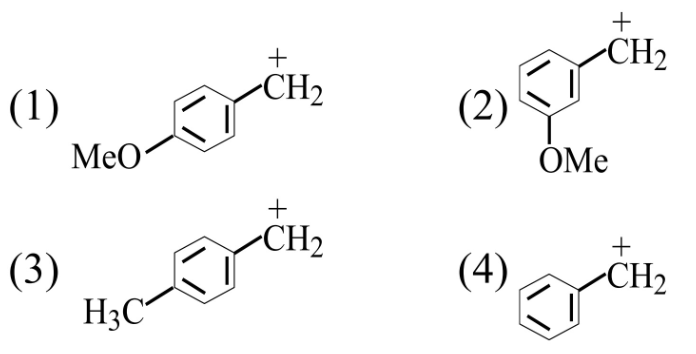
The most stable carbocation from the following is :
- A
1
- B
2
- C
3
- D
4
Solution
Given
- Four benzyl cations: p-methoxy (A), m-methoxy (B), p-methyl (C) and unsubstituted benzyl (D).
IdeaA ring substituent that pushes electron density onto the benzylic carbon stabilises the cation. Resonance donation (+M) reaches the benzylic carbon only from the ortho or para position.
Steps
Para methoxy donates strongly
Option A: para is a strong +M donor. The oxygen lone pair delocalises through the ring onto the benzylic carbon, giving an extra resonance form in which every atom has an octet. This strongly stabilises the cation.
Para methyl donates weakly
Option C: para donates only weakly, by hyperconjugation and +I. It stabilises the cation, but less than para .
Plain benzyl has ring resonance only
Option D: the plain benzyl cation has only ring resonance, with no extra help from a substituent.
Meta methoxy destabilises
Option B: only the electron-withdrawing effect of oxygen operates, so this cation is destabilised.
Key stepFrom the meta position, the oxygen lone pair cannot delocalise onto the benzylic carbon.Stability order
Stability order:
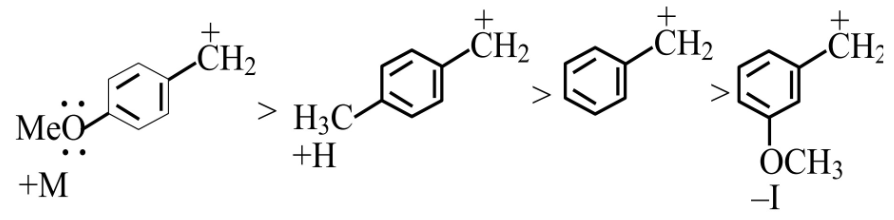
AnswerOption A: the p-methoxybenzyl cation is the most stable
TrapTreating the electronegative oxygen of as only electron-withdrawing (), so that para methyl, with hyperconjugation, looks like the best donor, leads to Option C. At the para position the donation of the oxygen lone pair far outweighs its effect.
Concept behind this question
Resonance & Mesomeric EffectNotes, formulas and examples →More previous year questions on Resonance & Mesomeric Effect
Practice more Chemistry
Concept-wise practice with instant solutions on Fundamenthol.
Start practicing →