JEE Main 2025 Jan 29 Shift 2, Chemistry Q5: Resonance & Mesomeric Effect
Learn this concept: Resonance & Mesomeric Effect →
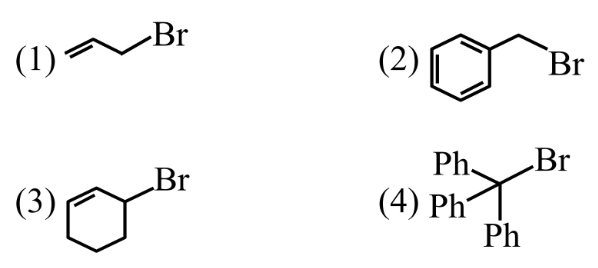
Which among the following halides will generate the most stable carbocation in Nucleophillic substitution reaction ?
- A
1
- B
2
- C
3
- D
4
- Four bromides: allyl bromide (A), benzyl bromide (B), 3-bromocyclohexene (C) and triphenylmethyl bromide (D)
- Loss of gives a carbocation
Steps
Option A: allyl cation
Allyl bromide gives a primary allyl cation. The charge is shared over two carbons through one C=C bond.
Option B: benzyl cation
Benzyl bromide gives a benzyl cation. The charge spreads into one benzene ring (the benzylic carbon and the ortho and para positions).
Option C: cyclohexenyl cation
3-bromocyclohexene gives the cyclohexenyl cation, a secondary allylic cation. The charge is shared between C1 and C3 through the adjacent C=C bond, with some extra help from the ring alkyl groups. It is still delocalised over only one bond.
Option D: trityl cation
Triphenylmethyl bromide gives the trityl cation. The charge is delocalised into all three benzene rings, giving many resonance structures (ten in total).
Compare the stabilities
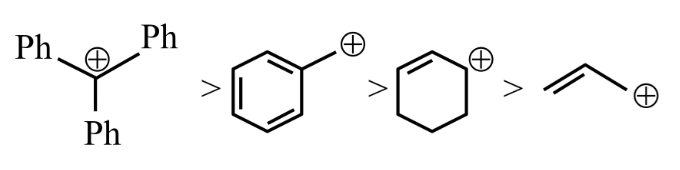
The trityl cation has by far the widest delocalisation of the positive charge, so it is the most stable: is more stable than the benzyl and cyclohexenyl cations, and the primary allyl cation is the least stable of the set.
Concept behind this question
Resonance & Mesomeric EffectNotes, formulas and examples →More previous year questions on Resonance & Mesomeric Effect
Practice more Chemistry
Concept-wise practice with instant solutions on Fundamenthol.
Start practicing →