JEE Advanced 2026 Paper 2, Chemistry Section 1 Q3: Properties and Important Reactions of Aldehydes & Ketones
Learn this concept: Properties and Important Reactions of Aldehydes & Ketones →
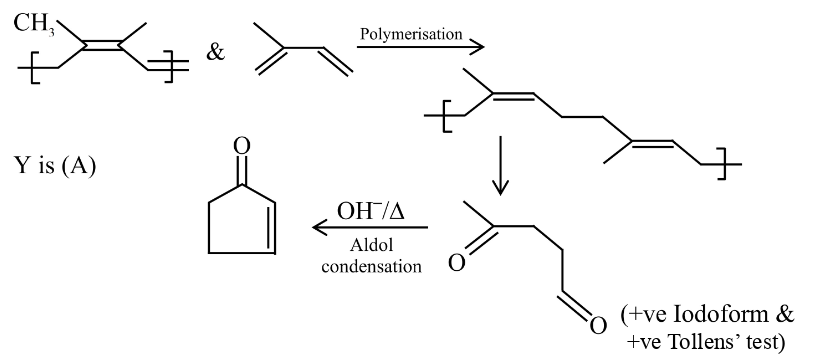
Natural rubber on complete ozonolysis (O/Zn-HO) gives compound as the major product. gives positive iodoform and Tollen's tests. on heating with aqueous NaOH gives as the major product. is

- A
(A)
- B
(B)
- C
(C)
- D
(D)
- Natural rubber (cis-1,4-polyisoprene) undergoes complete reductive ozonolysis (O/Zn-HO) to give X
- X is positive to both the iodoform and Tollens' tests
- X is heated with aqueous NaOH to give Y
Steps
Cleave the rubber repeat unit
The repeat unit of natural rubber is given below. Cleaving each C=C with O/Zn-HO turns into a ketone carbon and into an aldehyde carbon.
Identify X as 4-oxopentanal
Each unit therefore gives 4-oxopentanal as X. Its group gives a positive iodoform test, and its group gives a positive Tollens' test.
Form the enolate with base
X is a 1,4-dicarbonyl compound. With OH, the most useful enolate forms at the CH of the methyl ketone.
Key stepThis enolate attacks the aldehyde carbon in the same molecule.Count the ring size
The new ring contains the former CH carbon, the ketone carbon, the two CH carbons and the former CHO carbon. That is five atoms, giving 3-hydroxycyclopentanone.
Dehydrate to the enone
On heating, this -hydroxy ketone loses water. The C=C forms in conjugation with C=O, giving cyclopent-2-en-1-one.
Concept behind this question
Properties and Important Reactions of Aldehydes & Ketones Notes, formulas and examples →More previous year questions on Properties and Important Reactions of Aldehydes & Ketones
Practice more Chemistry Section 1
Concept-wise practice with instant solutions on Fundamenthol.
Start practicing →