JEE Advanced 2024 Paper 2, Chemistry Section 2 Q2: Properties and Important Reactions of Aldehydes & Ketones
Learn this concept: Properties and Important Reactions of Aldehydes & Ketones →
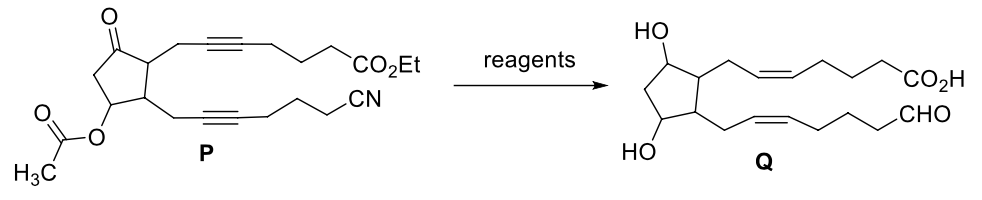
The option(s) with correct sequence of reagents for the conversion of P to Q is(are)
- A
i) Lindlar's catalyst, ; ii) ; iii) ; iv)
- B
i) Lindlar's catalyst, ; ii) ; iii) ; iv)
- C
i) ; ii) ; iii) ; iv) Lindlar's catalyst,
- D
i) Lindlar's catalyst, ; ii) ; iii) ; iv)
- P: ring ketone, ring acetate, two internal alkynes, an ethyl ester and a nitrile
- Q: two ring groups, two cis alkenes, a and a
- Options A, B, C, D give different orders of the four reagents
Steps
Key facts about each reagent
gives held as the tin chloride salt. This salt only becomes when water or acts. reduces the ketone but not esters or alkynes. Lindlar catalyst reduces only , not .
Key stepA free must never meet , and must not meet before .Option A works
Lindlar gives the cis alkenes. changes to the aldimine tin salt. No exists yet, so in step iii reduces only the ketone to . then releases , turns into and the acetate into . This gives Q. Correct.
Option B fails
in step ii hydrolyses to before the Stephen step, so no can form. Any that did appear would then be reduced by in step iv. Incorrect.
Option C works
reduces the ketone to . gives the aldimine salt. releases and hydrolyses both esters. Lindlar then reduces both alkynes to cis alkenes and leaves and untouched. This gives Q. Correct.
Option D works
Lindlar gives the cis alkenes. reduces the ketone. gives the aldimine salt. releases and hydrolyses both esters. This gives Q. Correct.
Concept behind this question
Properties and Important Reactions of Aldehydes & Ketones Notes, formulas and examples →More previous year questions on Properties and Important Reactions of Aldehydes & Ketones
Practice more Chemistry Section 2
Concept-wise practice with instant solutions on Fundamenthol.
Start practicing →