NEET 2026, Physics Q32: Semiconductors, p-n Junction Diode and Applications
Learn this concept: Semiconductors, p-n Junction Diode and Applications →
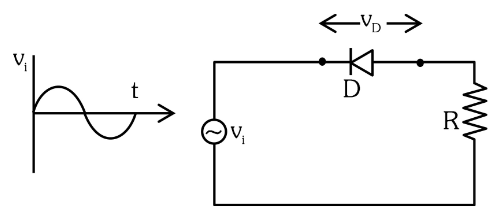
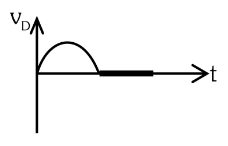
In the circuit shown below, the voltage appearing across the diode D will be of the form :
- A
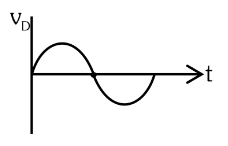
- B
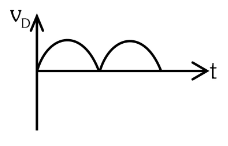
- C
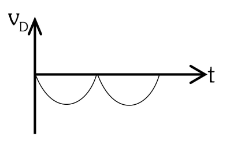
- D
- Sinusoidal source drives a diode D in series with a resistor R
- The diode's cathode (bar) faces the source's upper terminal and its anode faces R
Steps
Positive half-cycle biasing
Positive half-cycle (): the upper terminal of the source is at the higher potential.
Key stepThis terminal connects to the cathode, so the cathode is above the anode and the diode is reverse biased.Voltage across D when blocking
No current flows, so the drop across R is . By Kirchhoff's voltage law, the diode voltage follows the positive half of the sine wave.
Negative half-cycle biasing
Negative half-cycle (): the polarity reverses, the anode is now above the cathode, and the diode is forward biased.
Voltage across D when conducting
The conducting ideal diode acts as a closed switch, so the whole of appears across R.
Match the waveform
The voltage across D is therefore one positive half-cycle followed by zero for the next half-cycle. This is the waveform in Option D.
Concept behind this question
Semiconductors, p-n Junction Diode and ApplicationsNotes, formulas and examples →More previous year questions on Semiconductors, p-n Junction Diode and Applications
Practice more Physics
Concept-wise practice with instant solutions on Fundamenthol.
Start practicing →