NEET 2024, Physics Q18: Lenz’s Law
Learn this concept: Lenz’s Law →
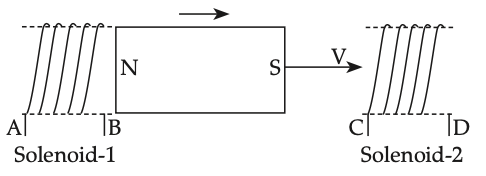
In the diagram, a strong bar magnet is moving towards solenoid-2 from solenoid-1. The direction of induced current in solenoid-1 and that in solenoid-2, respectively, are through the directions:
- A
AB and CD
- B
BA and DC
- C
AB and DC
- D
BA and CD
- Bar magnet has its N end facing solenoid-1 and its S end facing solenoid-2.
- The magnet moves to the right, away from solenoid-1 and towards solenoid-2.
- Both solenoids are wound in the same sense.
Steps
Solenoid-1 face polarity
The N end is moving away, so the flux through solenoid-1 falls. The coil tries to pull the magnet back. Its face nearer the magnet (end B) therefore becomes a south pole, which attracts the N end.
Key stepA coil attracts a receding magnet and repels an approaching one.Current in solenoid-1
Field lines enter a coil at its S face, so inside solenoid-1 the field points from B towards A (to the left). By the right-hand rule with the winding shown, this needs current from A to B.
Solenoid-2 face polarity
The S end is approaching, so the flux through solenoid-2 rises. The coil pushes the magnet back. Its face nearer the magnet (end C) therefore becomes a south pole, which repels the S end.
Current in solenoid-2
With a south pole at C, the field inside points from C towards D (to the right). This is opposite to the field in solenoid-1. Since the winding is the same, the current must also run the opposite way, from D to C.
Combine the two currents
The induced currents are therefore AB in solenoid-1 and DC in solenoid-2.
Concept behind this question
Lenz’s LawNotes, formulas and examples →Practice more Physics
Concept-wise practice with instant solutions on Fundamenthol.
Start practicing →