NEET 2023, Biology Q47: Mendel's laws of Inheritance
NEET2023Biology
Learn this concept: Mendel's laws of Inheritance →
Q.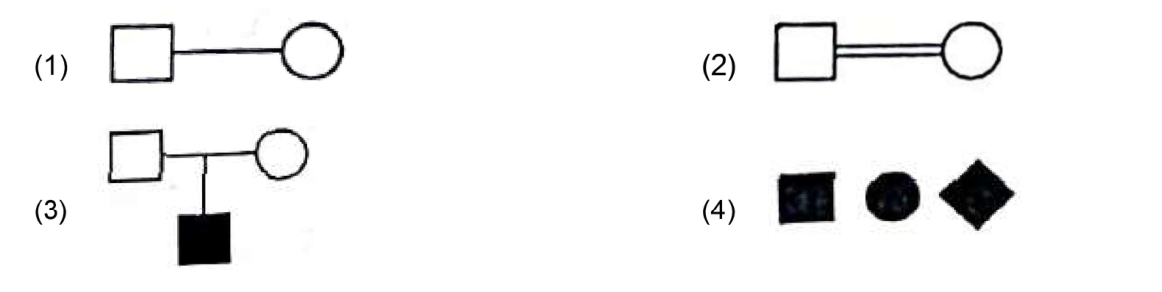
Which one of the following symbols represents mating between relatives in human pedigree analysis?
- A
1
- B
2
- C
3
- D
4
Solution
Given
- Four pedigree symbols: (1) square and circle joined by a single line
- (2) square and circle joined by a double line
- (3) parents with an affected son
- (4) filled square, circle and diamond
IdeaIn standard pedigree notation, a mating line between a male and a female is single for an ordinary mating and double for a consanguineous mating, that is, mating between relatives.
Steps
Single line is ordinary mating
Symbol (1): a single horizontal line joining a male (square) and a female (circle) shows an ordinary mating between unrelated individuals.
Double line marks relatives
Symbol (2): a double horizontal line joining a male and a female shows a consanguineous mating, which is mating between relatives.
Key stepOnly the double line between male and female marks consanguinity.Parents with affected son
Symbol (3): parents joined by a line with a vertical line down to a shaded square shows parents with an affected male offspring.
Filled symbols show affected
Symbol (4): filled square, circle and diamond show an affected male, an affected female and an affected individual of unspecified sex.
AnswerOption B: symbol (2), the double-line symbol
TrapStudents who take any line joining a male and a female to mean a related couple pick symbol (1), Option A. A single line shows ordinary mating between unrelated individuals; only the double line of symbol (2) marks consanguineous mating.
Concept behind this question
Mendel's laws of InheritanceNotes, formulas and examples →More previous year questions on Mendel's laws of Inheritance
Practice more Biology
Concept-wise practice with instant solutions on Fundamenthol.
Start practicing →