NEET 2023, Physics Q31: Thin Lens and Mirrors
NEET2023Physics
Learn this concept: Thin Lens and Mirrors →
Q.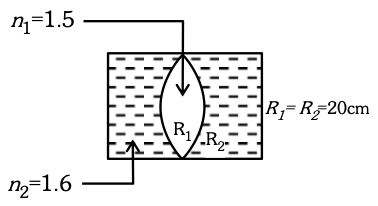
In the figure shown here, what is the equivalent focal length of the combination of lenses (Assume that all layers are thin)?
- A
cm
- B
cm
- C
cm
- D
cm
Solution
Given
- Biconvex glass lens: , cm
- Liquid layer: , outer faces flat
- All lenses thin
IdeaThe arrangement acts as three thin lenses in contact: a plano-concave liquid lens, the biconvex glass lens, and a second plano-concave liquid lens. Their powers add.
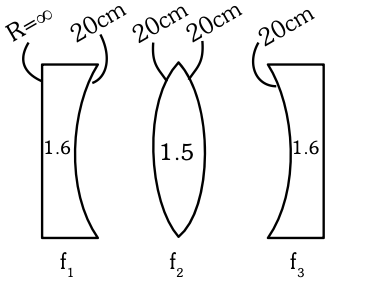
Steps
Left liquid lens power
Left liquid lens (). Light travels left to right. Its first face is flat, so . Its second face touches the bulging glass, whose centre of curvature lies to the right, so cm. Then:
cmGlass lens power
Glass lens (), with cm and cm:
cmRight liquid lens power
Right liquid lens (). Its first face has its centre of curvature to the left, so cm. Its second face is flat. Then:
cmAdd the three powers
Combine the three powers, which add for thin lenses in contact: .
cmEquivalent focal length
Therefore the combination behaves as a diverging lens.
cm
AnswerOption B: cm
Faster wayThe flat outer faces have no power, so only the two curved glass and liquid interfaces count. Each has power , so cm. This gives cm directly.
TrapStudents who read the label cm as a total, and so take each radius as cm, double every power. They get cm, which gives cm, Option C.
Concept behind this question
Thin Lens and MirrorsNotes, formulas and examples →More previous year questions on Thin Lens and Mirrors
Practice more Physics
Concept-wise practice with instant solutions on Fundamenthol.
Start practicing →