JEE Main 2026 Jan 24 Shift 1, Physics Q24
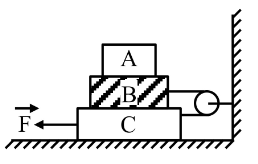
In the given figure the blocks A, B and C weigh 4 kg, 6 kg and 8 kg respectively. Block A is held at rest by a horizontal string tied to the wall (not shown in the figure). The co-efficient of sliding friction between any two surfaces is 0.5. The force required to slide the block C with constant speed is _______ N. (Used m/s)
- kg, kg, kg
- at every surface, m/s
- One string runs from B, round the wall pulley, and back to C
- Block A is held at rest by a horizontal string tied to the wall
- C is pulled left at constant speed
Steps
Motion of the blocks
C moves left with speed , so B moves right with speed . A stays at rest, so B slides under A and over C.
Kinetic friction at each surface
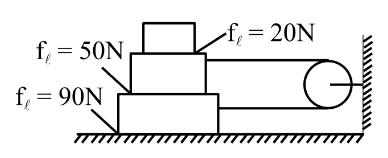
Each friction comes from its normal force: N, N, N.
Tension from equilibrium of B
Block B moves right, so both frictions on it point left. The string pulls B to the right with tension .
NForce F from equilibrium of C
Block C moves left, so three forces on it point right: friction from B (50 N), ground friction (90 N), and the same string pulling with .
NKey stepThe same string that pulls B right also pulls C back with tension , so appears in the balance of C too.
Practice more Physics
Concept-wise practice with instant solutions on Fundamenthol.
Start practicing →