JEE Main 2026 Jan 23 Shift 2, Chemistry Q10: Mechanism of Some Important Reactions of Alkenes
Learn this concept: Mechanism of Some Important Reactions of Alkenes →
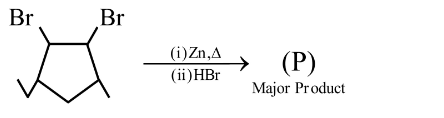
Identify (P)
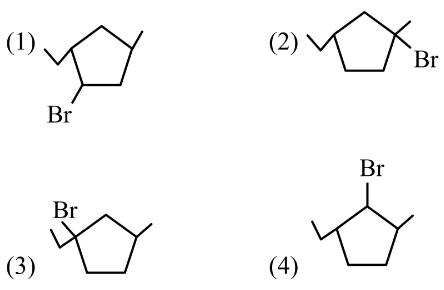
- A
1
- B
2
- C
3
- D
4
- Cyclopentane with Br on two adjacent ring carbons
- The ring carbon next to one C–Br bears a methyl group, and the ring carbon next to the other C–Br bears an ethyl group
- Reagents: (i) Zn, heat; (ii) HBr
Steps
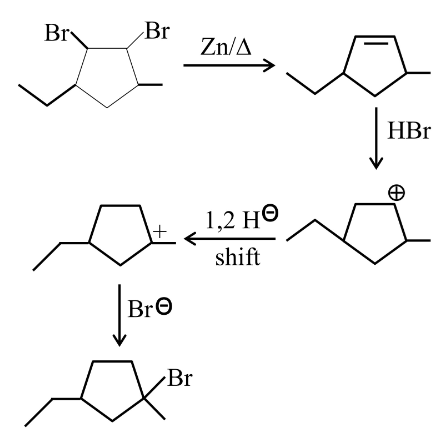
Debromination gives the alkene
takes both Br atoms and a double bond forms between the two carbons that carried them. Numbering C1 and C2 for the alkene carbons, this gives 3-ethyl-5-methylcyclopent-1-ene. C5 carries the methyl group (next to C1) and C3 carries the ethyl group (next to C2).
Protonation gives secondary cations
can add to either alkene carbon. Both choices give a secondary cation with the same number of α-H atoms (three), so neither route is favoured at this stage. One cation sits next to the CH bearing the methyl group. The other sits next to the CH bearing the ethyl group.
1,2-H shift to tertiary cations
Each secondary cation takes the hydride from the neighbouring substituted CH. This gives a tertiary cation either at the methyl-bearing carbon or at the ethyl-bearing carbon.
Compare the tertiary cations
At the methyl-bearing carbon there are (from ) (two ring ) α-H. At the ethyl-bearing carbon there are (from the of ethyl) α-H. The major path goes through the methyl-bearing tertiary cation.
α-HKey stepMore hyperconjugation makes the methyl-bearing tertiary cation more stable.Bromide captures the cation
attacks this tertiary carbon. The product has Br and on the same ring carbon, with the ethyl group 1,3 to it. This is 1-bromo-3-ethyl-1-methylcyclopentane.
Why the other options fail
Option A is the unrearranged secondary bromide. Option C comes from the less stable tertiary cation (6 α-H). Option D puts Br on the ring between the two substituted carbons, and no cation in this mechanism forms there.
Concept behind this question
Mechanism of Some Important Reactions of AlkenesNotes, formulas and examples →More previous year questions on Mechanism of Some Important Reactions of Alkenes
Practice more Chemistry
Concept-wise practice with instant solutions on Fundamenthol.
Start practicing →