JEE Main 2026 Jan 22 Shift 2, Chemistry Q2: Preparation of Alkynes
JEE Main2026Jan 22, Shift 2Chemistry
Learn this concept: Preparation of Alkynes →
Q.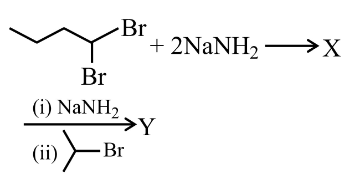
Consider the following reaction :
The product Y formed is :
- A
2-methylhex-2-yne
- B
5-methylhex-2-yne
- C
2-methylhex-3-yne
- D
Isopropylbut-1-yne
Solution
Given
- 1,1-dibromobutane, , is treated with 2 to give X
- X is then treated with and then isopropyl bromide, , to give Y
IdeaA geminal dihalide loses two HBr to (double E2) and forms an alkyne. The terminal alkyne is then converted to an acetylide ion, which is alkylated by the alkyl halide.
Steps
Double dehydrobromination gives X
Double dehydrobromination of the geminal dibromide. So X is but-1-yne.
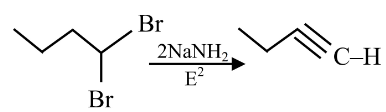
Acetylide ion formation
The terminal is weakly acidic, and removes it.
SN2 alkylation with isopropyl bromide
The acetylide carbon attacks the carbon of isopropyl bromide that carries Br ().
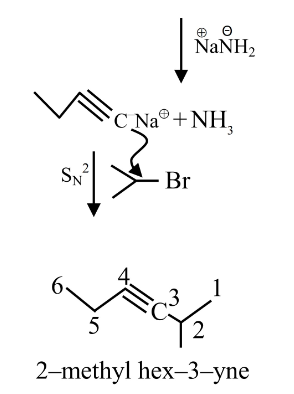
Naming Y
Naming Y: the longest chain containing the triple bond has 6 carbons. The name is 2-methylhex-3-yne.
Key stepThe triple bond lies between C3 and C4 whichever end is chosen, so numbering starts from the isopropyl end to give the methyl the lower number.
AnswerOption C: 2-methylhex-3-yne,
TrapStudents keep but-1-yne as the parent chain and simply add the isopropyl group as a substituent, which gives Option D, isopropylbut-1-yne. IUPAC rules require the longest chain through the triple bond, which here has six carbons, so the correct name is 2-methylhex-3-yne.
Concept behind this question
Preparation of AlkynesNotes, formulas and examples →More previous year questions on Preparation of Alkynes
Practice more Chemistry
Concept-wise practice with instant solutions on Fundamenthol.
Start practicing →