JEE Main 2025 Apr 4 Shift 2, Chemistry Q19: Valence Shell Electron Pair Repulsion (VSEPR) Theory
Learn this concept: Valence Shell Electron Pair Repulsion (VSEPR) Theory →
Given below are two statements:
Statement (I) : for , all three possible structures may be drawn as follows.
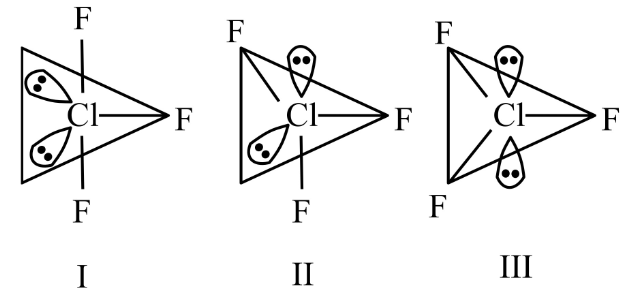
Statement (II) : Structure III is most stable, as the orbitals having the lone pairs are axial, where the repulsion is minimum.
In the light of the above statements, choose the most appropriate answer from the options given below:
- A
Statement I is incorrect but statement II is correct.
- B
Statement I is correct but statement II is incorrect.
- C
Both Statement I and statement II are correct.
- D
Both Statement I and statement II are incorrect.
- has 3 bond pairs and 2 lone pairs on Cl, so 5 electron pairs
- The figure shows the lone pairs equatorial (I), one axial and one equatorial (II), and both axial (III)
Steps
Statement I: three possible structures
Five electron pairs around Cl give hybridisation and a trigonal bipyramidal arrangement. Two lone pairs can sit only as equatorial–equatorial, axial–equatorial or axial–axial. These are exactly structures I, II and III, so Statement I is correct.
Count repulsions in structure I
Count the repulsions involving lone pairs in each structure. I: each equatorial lone pair is at to the two axial F, giving 4 lp–bp at and 0 lp–lp at (the lone pairs are apart).
Count repulsions in structure II
II: the axial lone pair is at to the equatorial lone pair and to two equatorial F. The equatorial lone pair is at to the axial F. This gives 3 lp–bp and 1 lp–lp at . The lp–lp repulsion is the strongest kind, so II is less stable than I.
Structure III and Statement II
III: both lone pairs are axial, as Statement II says. Each is at to all three equatorial F, giving 6 lp–bp at . This is the largest lp–bp repulsion of the three structures. III is the least stable structure and I, the T-shape, is the most stable. Statement II is incorrect.
Key stepAxial lone pairs maximise lp–bp repulsion rather than minimise it.
Concept behind this question
Valence Shell Electron Pair Repulsion (VSEPR) Theory Notes, formulas and examples →More previous year questions on Valence Shell Electron Pair Repulsion (VSEPR) Theory
Practice more Chemistry
Concept-wise practice with instant solutions on Fundamenthol.
Start practicing →