JEE Advanced 2026 Paper 2, Chemistry Section 4 Q3: Qualitative and Quantitative Analysis
Learn this concept: Qualitative and Quantitative Analysis →
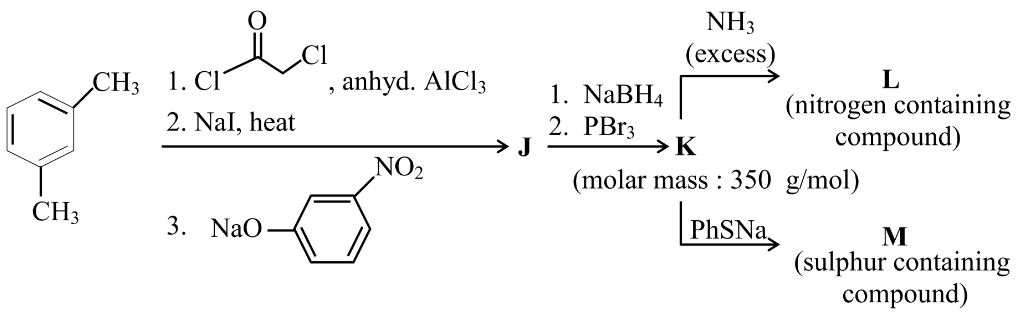
Question Stem (Q3-Q4). Consider the following reaction sequence in which and are the major products.
Given: Atomic mass (in amu): H: 1, C: 12, N: 14, O: 16, S: 32, Br: 80, Ba: 137.
Q3. The volume of M aqueous HSO required to completely neutralize the ammonia evolved from g of in Kjeldahl's method of nitrogen estimation is _____ mL.
- m-Xylene is acylated with ClCOCHCl/AlCl, then NaI, then sodium m-nitrophenoxide, giving J
- NaBH then PBr gives K (350 g/mol)
- K with excess NH gives L
- Mass of L = 5.72 g
- HSO = 1 M
Steps
Find J from m-xylene
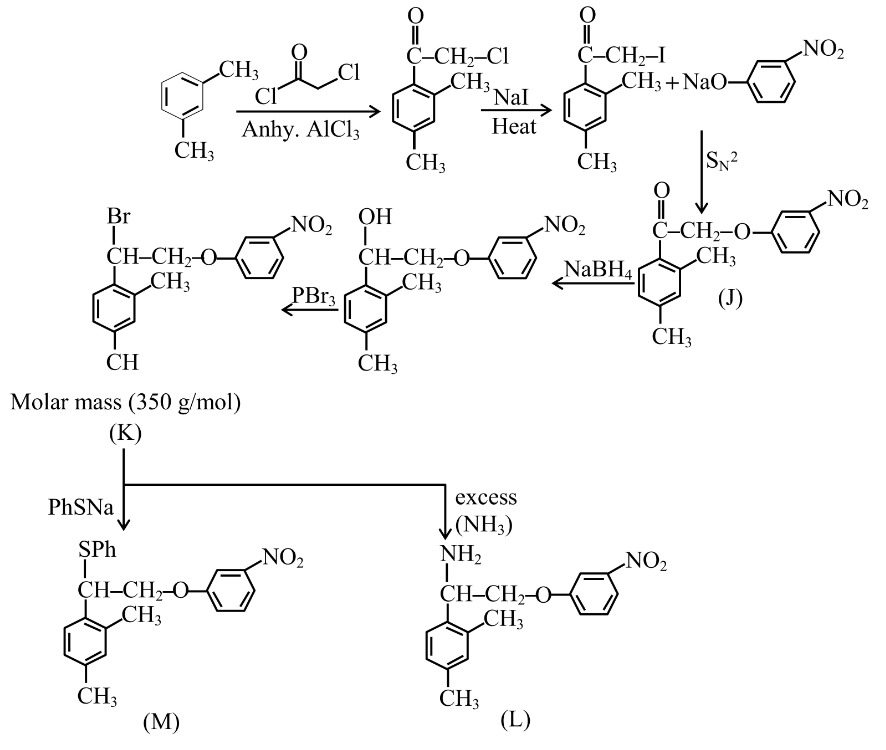
Friedel-Crafts acylation occurs at C-4 of m-xylene, ortho to one methyl and para to the other, giving 2,4-(CH)CHCOCHCl. NaI exchanges Cl for I. The phenoxide then displaces iodide by S2, so J is 2,4-(CH)CHCOCHOCHNO (m-nitro).
Find K and check its mass
NaBH reduces C=O to CH(OH), and PBr converts it to CHBr. K = CHBrNO, with molar mass 350 g/mol, which matches the given value.
Find L and its molar mass
Excess NH replaces Br by NH. L = CHNO, so its molar mass is 286 g/mol.
Moles of NH evolved
Moles of L as below. Only the NH nitrogen gives NH, so NH evolved mol.
Key stepOnly the NH nitrogen gives NH; the nitro nitrogen does not.Neutralise with HSO
Two NH react with one HSO, so HSO needed mol. Volume mL.
Concept behind this question
Qualitative and Quantitative AnalysisNotes, formulas and examples →More previous year questions on Qualitative and Quantitative Analysis
Practice more Chemistry Section 4
Concept-wise practice with instant solutions on Fundamenthol.
Start practicing →