JEE Advanced 2026 Paper 2, Chemistry Section 2 Q4: Properties of Phenol
Learn this concept: Properties of Phenol →
In the following reaction sequence, and are the major products.
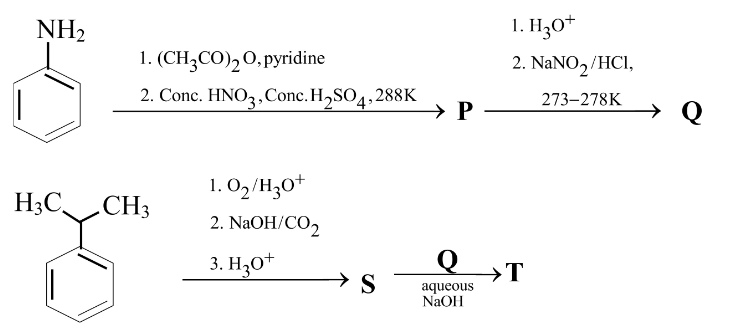
The correct statement(s) about and is (are)
- A
(A) on treatment with ethanol generates an aromatic aldehyde.
- B
(B) gives positive phthalein dye test.
- C
(C) is a dinitro compound.
- D
(D) is a coloured compound.
- Aniline: (CHCO)O/pyridine, then conc. HNO/conc. HSO at 288 K gives P
- P: HO, then NaNO/HCl at 273 to 278 K gives Q
- Cumene: O/HO, then NaOH/CO, then HO gives S
- S with Q in aqueous NaOH gives T
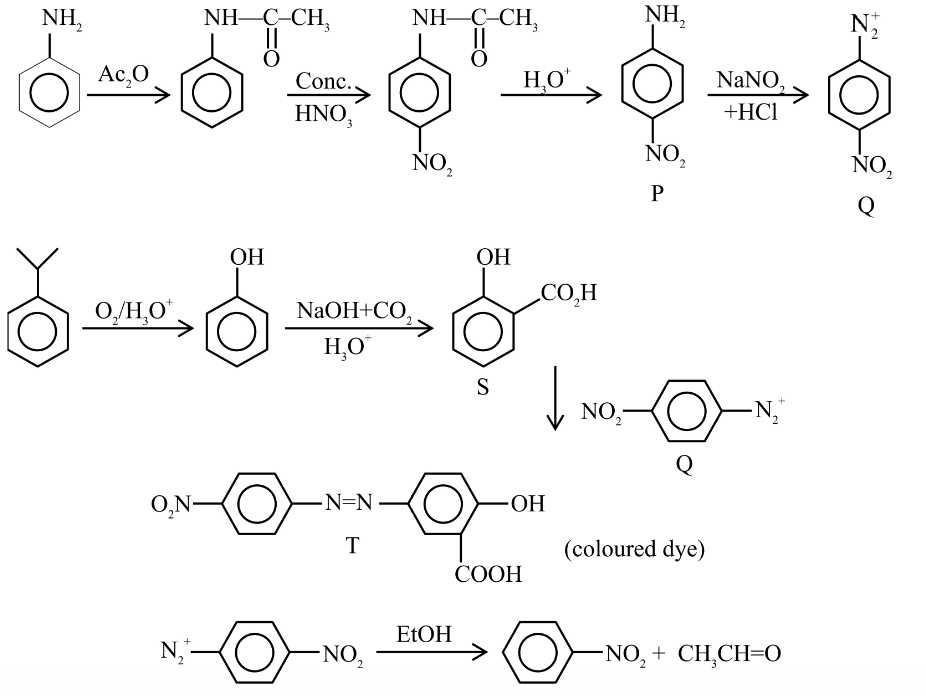
Steps
Identify P
Acetic anhydride/pyridine converts aniline to acetanilide. The group is a moderate ortho/para director and protects the amine from oxidation, so nitration adds one NO group, mainly para. P is p-nitroacetanilide, a mono-nitro compound.
Key stepThe acetyl group protects the amine, so nitration adds only one NO group.Identify Q
HO removes the acetyl group to give p-nitroaniline. NaNO/HCl at 273 to 278 K then gives Q, p-nitrobenzenediazonium chloride.
Identify S
Cumene is oxidised to cumene hydroperoxide, which is cleaved by acid into phenol and acetone. With NaOH/CO (Kolbe reaction) followed by acid, phenol gives S, salicylic acid (2-hydroxybenzoic acid).
Identify T by azo coupling
In aqueous NaOH, the phenoxide of salicylate couples with Q para to the OH group. T is 5-(4-nitrophenylazo)salicylic acid, which contains the chromophore.
Option A: ethanol on Q
Ethanol replaces by H. Q gives nitrobenzene, and ethanol is oxidised to acetaldehyde, which is an aliphatic aldehyde. No aromatic aldehyde forms. Incorrect.
Options B and C
Option B: S has a free phenolic OH, so it condenses with phthalic anhydride to give a phthalein dye. Correct. Option C: P carries a single NO group, so it is not a dinitro compound. Incorrect.
Option D: colour of T
T is an azo dye with an extended conjugated system, so it is coloured. Correct.
Concept behind this question
Properties of PhenolNotes, formulas and examples →More previous year questions on Properties of Phenol
Practice more Chemistry Section 2
Concept-wise practice with instant solutions on Fundamenthol.
Start practicing →