JEE Advanced 2026 Paper 1, Chemistry Section 4 Q4: Preparation of Alkyl Halides (Halo Alkanes) & Aryl Halides (Halo Arenes)
Learn this concept: Preparation of Alkyl Halides (Halo Alkanes) & Aryl Halides (Halo Arenes) →
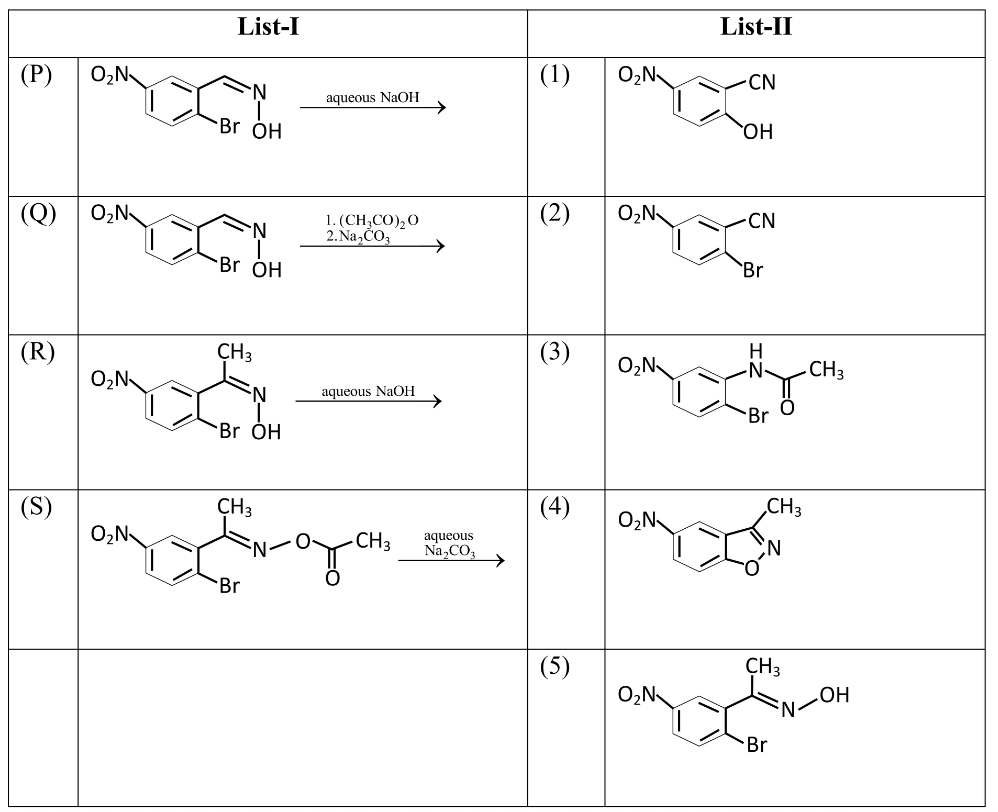
Match the major products obtained in the reactions given in List-I with the corresponding structures in List-II and choose the correct option.
- A
P 2; Q 1; R 5; S 4
- B
P 1; Q 2; R 4; S 5
- C
P 1; Q 2; R 3; S 4
- D
P 2; Q 1; R 3; S 5
- Br at C-2 with NO para to it (C-5), so the C–Br carbon is activated for nucleophilic aromatic substitution
- P and R are oximes with OH syn to the ring (toward Br)
- S is an O-acetyl ketoxime with the O-group anti to the ring
Steps
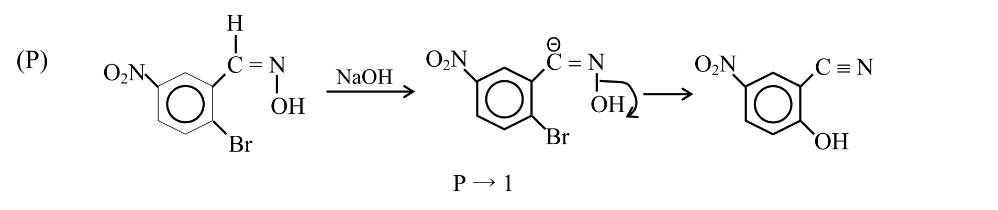
P: benzisoxazole, then ring opening
NaOH forms the oximate O, which attacks C-2 and expels Br, giving 5-nitro-1,2-benzisoxazole. Its C-3 carries an H. OH removes this H and the weak N–O bond breaks (ring opening to a nitrile), giving the phenoxide of 2-hydroxy-5-nitrobenzonitrile. P 1.
Q: nitrile forms, Br stays
AcO converts the oxime to ArCH=N–OAc. NaCO removes the aldehydic H and acetate leaves. The O is lost, so no internal nucleophile remains, and mild carbonate does not replace Br. Product: 2-bromo-5-nitrobenzonitrile. Q 2.
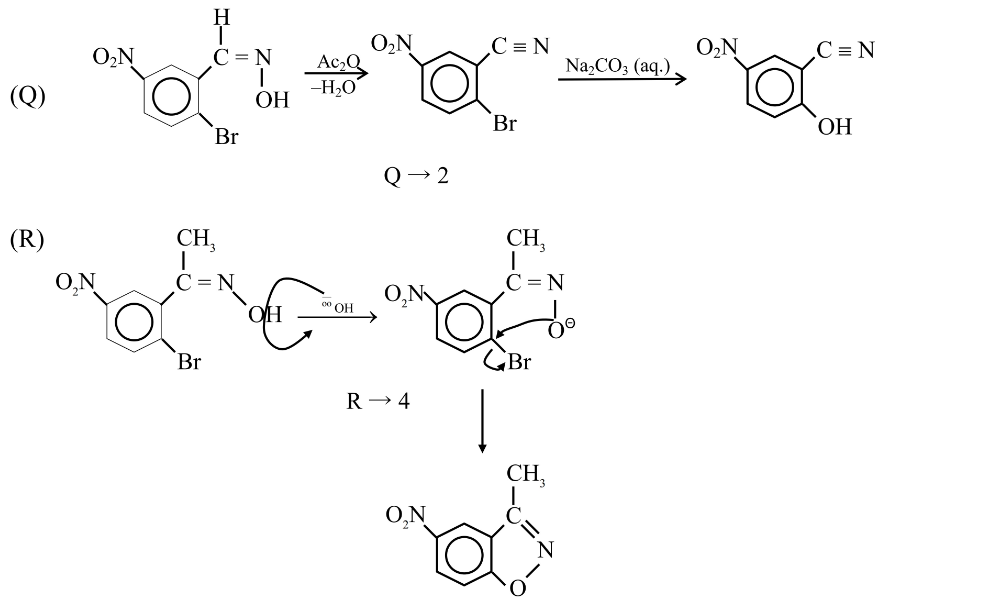
R: benzisoxazole is final
NaOH forms the oximate O, which displaces Br by intramolecular SAr, giving 3-methyl-5-nitro-1,2-benzisoxazole. R 4.
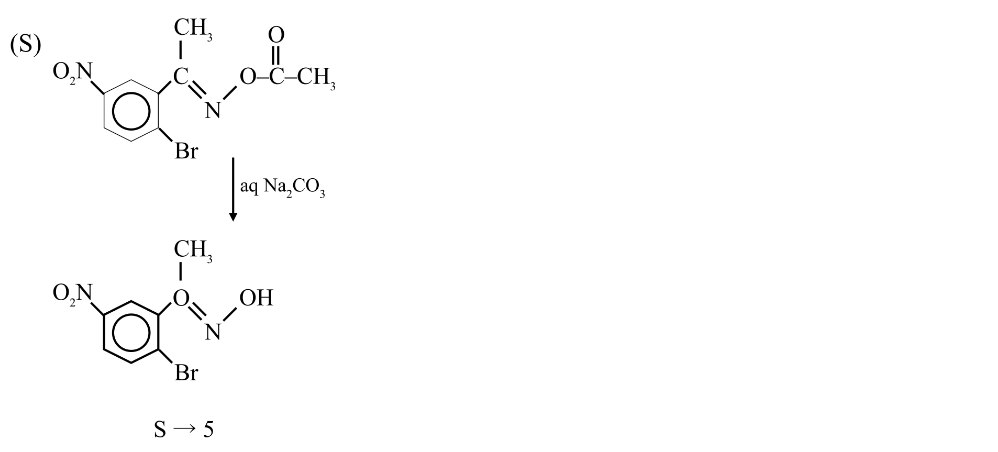
Key stepC-3 bears CH, not H, so the ring-opening of step 1 cannot occur and the benzisoxazole is the final product.S: only the ester hydrolyses
Aqueous NaCO hydrolyses the O-acetyl ester, releasing the free ketoxime Ar–C(CH)=N–OH. Its OH is anti to the ring, so it cannot reach C-2 and no cyclisation occurs. With no H on the oxime carbon, no nitrile can form either. S 5.
Concept behind this question
Preparation of Alkyl Halides (Halo Alkanes) & Aryl Halides (Halo Arenes)Notes, formulas and examples →More previous year questions on Preparation of Alkyl Halides (Halo Alkanes) & Aryl Halides (Halo Arenes)
Practice more Chemistry Section 4
Concept-wise practice with instant solutions on Fundamenthol.
Start practicing →