JEE Advanced 2026 Paper 1, Physics Section 3 Q1: Simple Harmonic Motion And Oscillation
Learn this concept: Simple Harmonic Motion And Oscillation →
A tank contains two immiscible liquids of densities and . The higher density liquid is filled up to a height from the bottom. A thin rod of density and length is fully immersed and hinged at the bottom so that it can oscillate freely, as shown in the figure. If the rod is slightly disturbed from its equilibrium, the time period of small oscillations is , where is the acceleration due to gravity. The value of is:
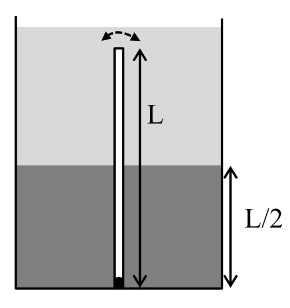
- Rod of length , cross-section , density , hinged at the bottom
- Lower layer: density , depth
- Upper layer: density , covering the rest of the rod
Steps
Forces on the rod
For small , the lower half (length ) stays in the liquid and the upper half stays in the liquid. Buoyancy on the lower half is , acting at from the hinge. Buoyancy on the upper half is , acting at from the hinge. The weight is , acting at from the hinge.
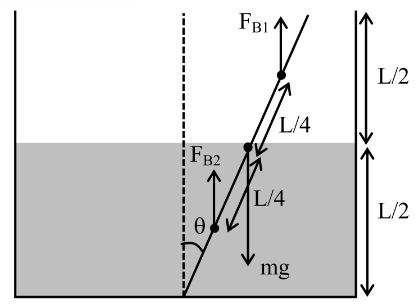 Key stepEach layer's buoyancy acts at the centre of the part of the rod immersed in that layer.
Torques about the hinge
Each vertical force at distance along the rod has lever arm . Buoyancy restores the rod and the weight opposes this, so the net restoring torque is:
Substitute the forces
Substitute the forces, using .
Moment of inertia
Moment of inertia about the hinge:
Equation of motion
The equation of motion gives the angular frequency.
Period and value of n
Comparing with gives .
Concept behind this question
Simple Harmonic Motion And OscillationNotes, formulas and examples →More previous year questions on Simple Harmonic Motion And Oscillation
Practice more Physics Section 3
Concept-wise practice with instant solutions on Fundamenthol.
Start practicing →