JEE Advanced 2025 Paper 2, Chemistry Section 1 Q3: Some Basic Principles of Organic Chemistry
Monocyclic compounds P, Q, R and S are the major products formed in the reaction sequences given below.
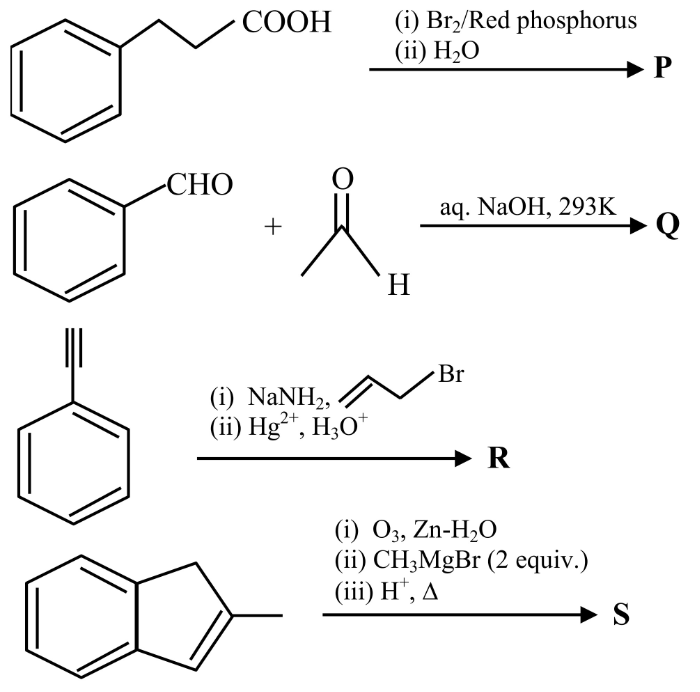
The product having the highest number of unsaturated carbon atom(s) is-
- A
P
- B
Q
- C
R
- D
S
- Four reaction sequences give monocyclic products P, Q, R and S.
- Find the product with the most unsaturated (sp or sp) carbon atoms.
Steps
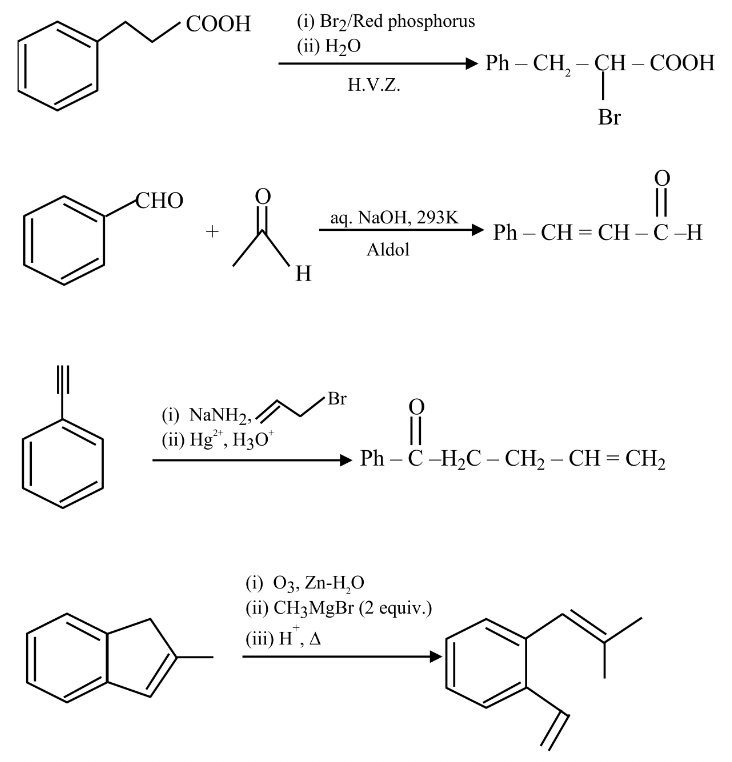
P by Hell-Volhard-Zelinsky
The Hell-Volhard-Zelinsky reaction brominates the -carbon of PhCHCHCOOH, giving Ph-CH-CHBr-COOH. Unsaturated carbons:
Q by crossed aldol condensation
Crossed aldol condensation of PhCHO with CHCHO, followed by dehydration into conjugation, gives cinnamaldehyde, Ph-CH=CH-CHO. Unsaturated carbons:
R by alkylation and hydration
NaNH forms the acetylide, and allyl bromide alkylates it to give Ph-CC-CH-CH=CH. Hg/HO hydrates the triple bond. The carbonyl forms on the benzylic carbon, giving Ph-CO-CH-CH-CH=CH. Unsaturated carbons:
S, ozonolysis of 2-methylindene
This gives o-OHC-CH-CH-CO-CH, which has an aldehyde and a methyl ketone.
Key stepOzonolysis with Zn-HO cleaves the C2=C3 bond of 2-methylindene. This opens the five-membered ring.S, Grignard then dehydration
Two equivalents of CHMgBr convert the CHO group to CH(OH)CH and the ketone to C(OH)(CH). H with heat dehydrates both alcohols, forming alkenes conjugated with the ring. This gives o-(CH=CH)-CH-CH=C(CH). Unsaturated carbons:
Compare the four counts
Comparison: S has the most unsaturated carbons.
Practice more Chemistry Section 1
Concept-wise practice with instant solutions on Fundamenthol.
Start practicing →