JEE Advanced 2025 Paper 2, Physics Section 3 Q6: Young’s Double Slit Experiment
Learn this concept: Young’s Double Slit Experiment →
In a Young's double slit experiment, a combination of two glass wedges and , having refractive indices 1.7 and 1.5, respectively, are placed in front of the slits, as shown in the figure. The separation between the slits is mm and the shortest distance between the slits and the screen is m. Thickness of the combination of the wedges is m. The value of as shown in the figure is 1 mm. Neglect any refraction effect at the slanted interface of the wedges. Due to the combination of the wedges, the central maximum shifts (in mm) with respect to O by ____
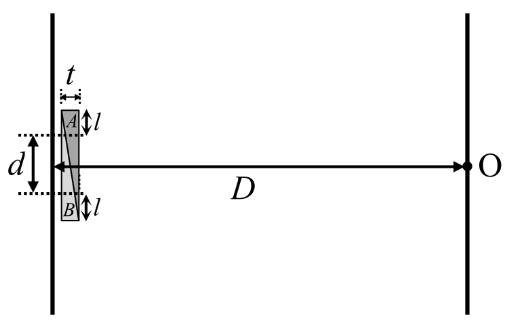
- ,
- m, mm
- mm, m
- The wedge combination spans mm vertically
- Wedge is thickest at the top and wedge is thickest at the bottom
Steps
Thicknesses at the upper slit
The thickness of falls linearly from m at the top to at the bottom over mm. The upper slit is mm below the top, so there m and m.
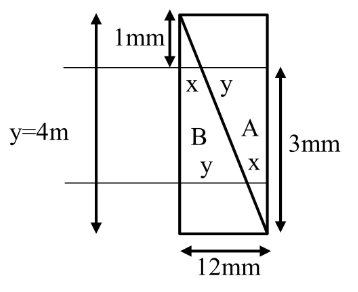
Thicknesses at the lower slit
The lower slit is mm below the top, so there m and m.
Extra path at upper slit
Extra optical path at the upper slit:
Extra path at lower slit
Extra optical path at the lower slit:
Net path difference
The net path difference is m. The upper slit has the larger added path, so the central maximum shifts upward.
Shift of central maximum
Shift: , which gives m mm.
Concept behind this question
Young’s Double Slit ExperimentNotes, formulas and examples →More previous year questions on Young’s Double Slit Experiment
Practice more Physics Section 3
Concept-wise practice with instant solutions on Fundamenthol.
Start practicing →