JEE Advanced 2025 Paper 2, Physics Section 3 Q4: Satellite, Planetary Motion And Kepler’s Law
Learn this concept: Satellite, Planetary Motion And Kepler’s Law →
A geostationary satellite above the equator is orbiting around the earth at a fixed distance from the center of the earth. A second satellite is orbiting in the equatorial plane in the opposite direction to the earth's rotation, at a distance from the center of the earth, such that . The time period of the second satellite as measured from the geostationary satellite is hours. The value of is _____
- Geostationary satellite at with period h
- Second satellite at in the equatorial plane, moving opposite to the earth's rotation
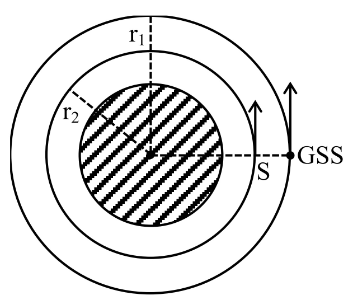
Steps
Ratio of angular speeds
Using , the ratio of the angular speeds is:
Relative angular speed
Their angular velocities are therefore opposite, so the relative angular speed is the sum of the two:
Key stepThe geostationary satellite moves with the earth's rotation and the second satellite moves against it.Period seen from geostationary satellite
Period seen from the geostationary satellite, in hours:
Compare with the given form
Compare with h:
Concept behind this question
Satellite, Planetary Motion And Kepler’s LawNotes, formulas and examples →More previous year questions on Satellite, Planetary Motion And Kepler’s Law
Practice more Physics Section 3
Concept-wise practice with instant solutions on Fundamenthol.
Start practicing →