JEE Advanced 2024 Paper 2, Physics Section 1 Q1: Faraday’s Law of Induction
Learn this concept: Faraday’s Law of Induction →
A region in the form of an equilateral triangle (in plane) of height has a uniform magnetic field pointing in the -direction. A conducting loop , in the form of an equilateral triangle of the same height , is placed in the plane with its vertex at in the orientation shown in the figure. At , the loop starts entering the region of the magnetic field with a uniform velocity along the -direction. The plane of the loop and its orientation remain unchanged throughout its motion.
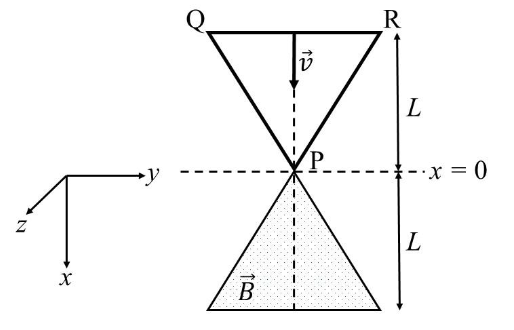
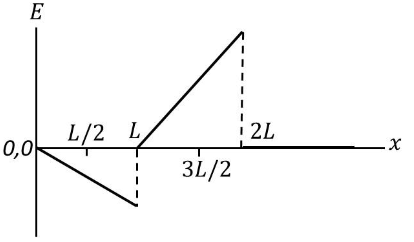
Which of the following graph best depicts the variation of the induced emf () in the loop as a function of the distance () starting from ?
- A
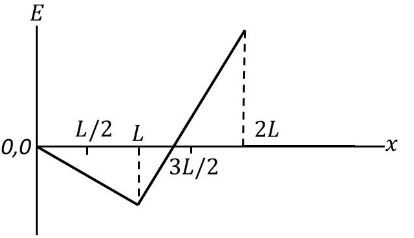
- B
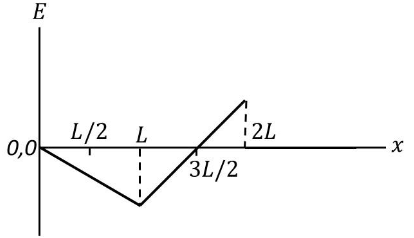
- C
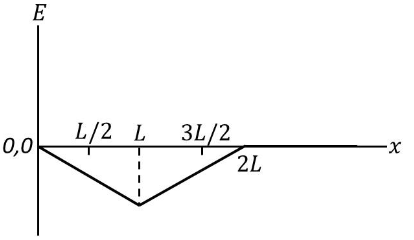
- D
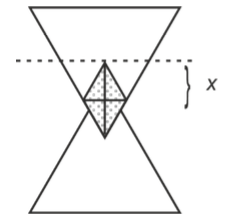
- Field region: equilateral triangle of height , apex at , base at
- Loop: same triangle pointing the other way, tip at after moving a distance with speed
Steps
Overlap area for 0 to L
For , the overlap is a rhombus of axial diagonal , with transverse diagonal . So
Emf for 0 to L
This gives the emf below. The emf is negative and grows linearly, reaching at .
Hexagon overlap for L to 2L
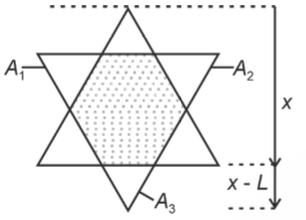
For , the tip has passed the field base and the loop base lies at . The overlap is a hexagon. Integrating the smaller half-width between and gives
Emf for L to 2L
Then , so . This is a straight line: at , at (between and ), and at .
Key stepThe zero of the emf is at , not at , and the peak at is twice the size of the minimum.Area vanishes at 2L
At the area is . Beyond there is no overlap, so drops to zero.
Match the graph
The required graph falls linearly to a minimum at . It then rises linearly, crosses zero before , and reaches a positive peak twice the size of the minimum at . After that it drops to zero. Only graph A has this shape.
Concept behind this question
Faraday’s Law of InductionNotes, formulas and examples →More previous year questions on Faraday’s Law of Induction
Practice more Physics Section 1
Concept-wise practice with instant solutions on Fundamenthol.
Start practicing →