JEE Advanced 2024 Paper 1, Physics Section 4 Q3: Refraction at Plane and Spherical surfaces
Learn this concept: Refraction at Plane and Spherical surfaces →
A light ray is incident on the surface of a sphere of refractive index at an angle of incidence . The ray partially refracts into the sphere with angle of refraction and then partly reflects from the back surface. The reflected ray then emerges out of the sphere after a partial refraction. The total angle of deviation of the emergent ray with respect to the incident ray is . Match the quantities mentioned in List-I with their values in List-II and choose the correct option.
| List-I | List-II |
|---|---|
| (P) If and , then all the possible values of will be | (1) and |
| (Q) If and , then all the possible values of will be | (2) and |
| (R) If and , then all the possible values of will be | (3) and |
| (S) If and , then all the possible values of will be | (4) |
| (5) |
- A
P 5; Q 2; R 1; S 4
- B
P 5; Q 1; R 2; S 4
- C
P 3; Q 2; R 1; S 4
- D
P 3; Q 1; R 2; S 5
- Ray refracts into the sphere, reflects once from the back surface and refracts out
- Snell's law at entry:
- is the total deviation
- List-I cases: (P) , ; (Q) , ; (R) , , find ; (S) ,
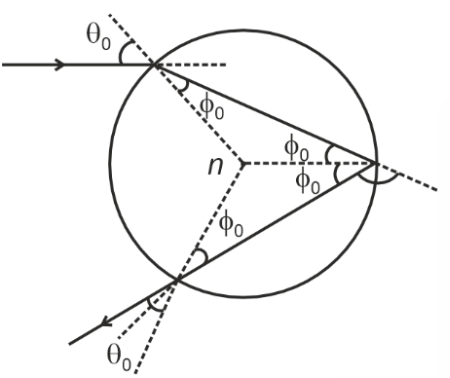
Steps
Total deviation formula
The deviation at entry is , at the reflection it is , and at exit it is . Hence
Condition for
For we need . Snell's law then gives , so . Therefore either or .
Case P:
Take . Then , which gives , the same root as . The only value is , so P 5.
Case Q:
Take . Then , so and . Adding the root , the values are and . So Q 2.
Case R: values of
In the same case the refraction angles are and , so R 1.
Case S:
Take and . Then , so . This gives , so S 4.
Concept behind this question
Refraction at Plane and Spherical surfacesNotes, formulas and examples →More previous year questions on Refraction at Plane and Spherical surfaces
Practice more Physics Section 4
Concept-wise practice with instant solutions on Fundamenthol.
Start practicing →