JEE Advanced 2023 Paper 2, Physics Section 4 Q4: Kinetic Theory of an Ideal Gases
Learn this concept: Kinetic Theory of an Ideal Gases →
PARAGRAPH-II
A cylindrical furnace has height () and diameter () both m. It is maintained at temperature K. The air gets heated inside the furnace at constant pressure and its temperature becomes K. The hot air with density rises up a vertical chimney of diameter m and height m above the furnace and exits the chimney (see the figure). As a result, atmospheric air of density kg m, pressure and temperature K enters the furnace. Assume air as an ideal gas, neglect the variations in and inside the chimney and the furnace. Also ignore the viscous effects.
[Given: The acceleration due to gravity ms and ]
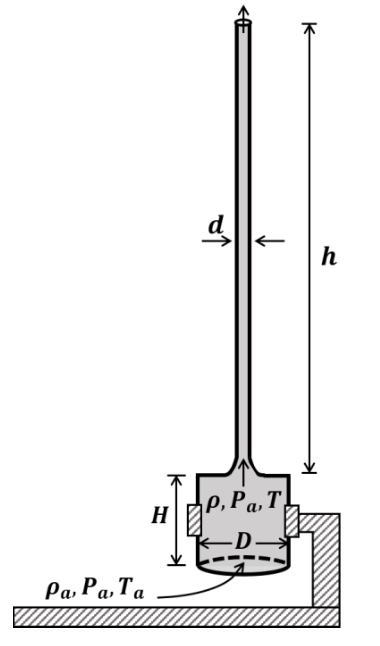
Q2. When the chimney is closed using a cap at the top, a pressure difference develops between the top and the bottom surfaces of the cap. If the changes in the temperature and density of the hot air, due to the stoppage of air flow, are negligible, the furnace base is at ground level, the hot air at the top of the furnace (the chimney entry) is at pressure and the outside air at ground level is at pressure , then the value of is ______ N m.
Edited by Fundamenthol: IIT dropped this question because it did not say where the pressure is taken, so 18, 20 and 30 N m could all be defended; we state that the furnace base is at ground level, the hot air at the chimney entry is at and the outside air at ground level is at , so that one answer is right.
- K, kg m
- K, m, m
- Hot air at the chimney entry is at
- Outside air at ground level is at
Steps
Density of the hot air
At the same pressure , ideal gas density varies as .
kg mPressure inside, below the cap
The hot column rises m above the chimney entry.
N mPressure outside, above the cap
The cap is m above the ground.
N mPressure difference across the cap
The higher pressure is on the bottom surface of the cap.
N m
Concept behind this question
Kinetic Theory of an Ideal GasesNotes, formulas and examples →More previous year questions on Kinetic Theory of an Ideal Gases
Practice more Physics Section 4
Concept-wise practice with instant solutions on Fundamenthol.
Start practicing →