JEE Advanced 2022 Paper 1, Physics Section 2 Q4: Reflection at Plane and Spherical Surfaces
Learn this concept: Reflection at Plane and Spherical Surfaces →
Three plane mirrors form an equilateral triangle with each side of length . There is a small hole at a distance from one of the corners as shown in the figure. A ray of light is passed through the hole at an angle and can only come out through the same hole. The cross section of the mirror configuration and the ray of light lie on the same plane.
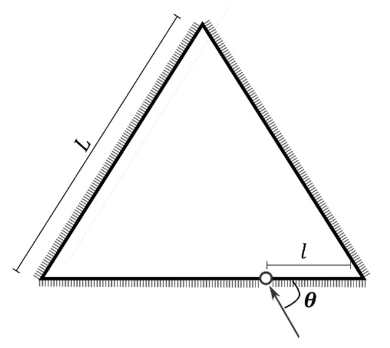
Which of the following statement(s) is(are) correct?
- A
The ray of light will come out for , for .
- B
There is an angle for at which the ray of light will come out after two reflections.
- C
The ray of light will NEVER come out for , and .
- D
The ray of light will come out for , and after six reflections.
- Equilateral mirror triangle of side
- Hole on the base at distance from the right corner
- Inside, the ray travels up and to the left, making angle with the base
- The ray can only leave through the same hole
Steps
Option A: normal incidence at 30°
The left corner (angle ), the hole (angle ) and the first hit point on the left mirror form a triangle. Its angle at the hit point follows from the angle sum. The foot of the perpendicular lies at from the left corner, which is on the mirror for every . Option A is correct.
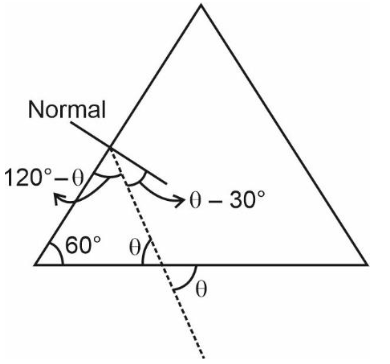 Key stepFor this angle is , so the ray meets the left mirror normally and returns along the same line to the hole.
Option B: hole at the midpoint
Take the hole at the midpoint of the base, with . The ray runs parallel to the right side and meets the left side at its midpoint . It strikes the left mirror at to the surface, so it reflects horizontally and meets the right side at its midpoint . There it reflects parallel to the left side and comes down to the base at the distance below from the right corner, which is itself. The ray exits after two reflections. Option B is correct.
General case at 60°
Let be the distance of the hole from the left corner. The ray is parallel to the right side, so it forms an equilateral triangle with the left corner and meets the left mirror at distance from that corner (reflection 1). It reflects horizontally. This cuts off an equilateral triangle of side at the apex, so the ray meets the right mirror at distance from the right corner (reflection 2). It then travels parallel to the left side and meets the base at distance from the right corner, that is, at distance from the left corner. This is the mirror image of the hole position, and it is the hole only when .
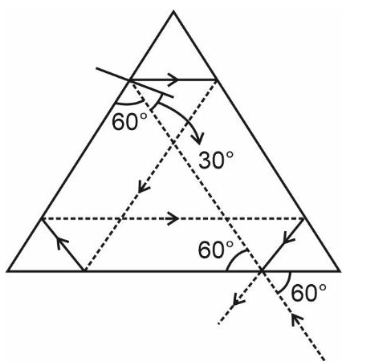
Reflections when l is not L/2
For the ray reflects from the base (reflection 3) and again leaves at , now from a point at distance from the left corner. Repeating the previous step with replaced by gives reflections 4 and 5, on the left and right mirrors. The ray then lands at distance from the right corner, which is the hole. So for the ray always exits after 5 reflections when .
Options C and D are false
Option C: For the ray exits after 5 reflections, so the claim that it never comes out is false. Option D: For the ray exits after 5 reflections, not 6, so Option D is false.
Concept behind this question
Reflection at Plane and Spherical SurfacesNotes, formulas and examples →More previous year questions on Reflection at Plane and Spherical Surfaces
Practice more Physics Section 2
Concept-wise practice with instant solutions on Fundamenthol.
Start practicing →